
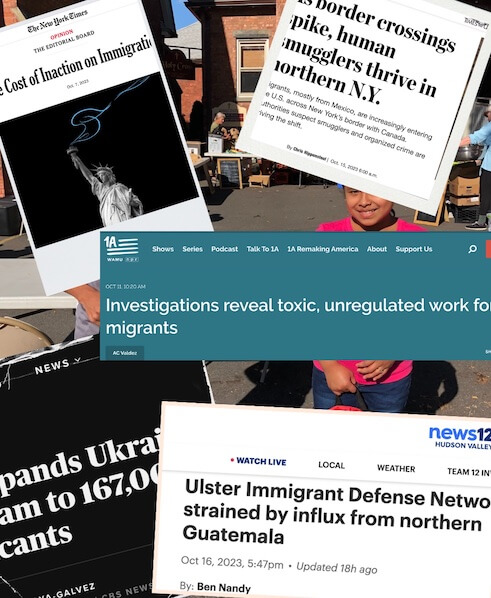
The Census Bureau and other data collectors always lag day-to-day reality. The numbers below are among the most recent available. To give you a sense of more recent increases in our area: UIDN’s food market has seen a 20 percent increase over the last year. The immigrants in our community . . .
Seek opportunity, refuge, and stability. Their home countries have often suffered from centuries of colonialism, resource exploitation, and governments that serve the few, not the many. They are fleeing climate crises that make it impossible to make a living as well as corruption and political or gang violence. They come from Guatemala, Mexico, El Salvador, Ecuador, Belize, Mauritania, Ukraine, Afghanistan, Venezuela, and more.
Are a fast-growing part of our community. The Mid-Hudson Valley, which includes Ulster County, had more than 20,000 undocumented residents in 2018. Between 2017 and 2021 the overall category of foreign-born residents in Ulster County grew from 7 percent to 14 percent.
Take on tough, essential jobs. According to the Pew Research Center 4.6% of U.S. workers in 2021 were unauthorized immigrants; this number has held since 2017. Historically, immigrants have done the most demanding and dangerous jobs in agriculture, construction, food processing and serving, personal care, landscaping, and the like.
Recent immigrants are no exception. Their work is often poorly paid, and they are rarely eligible for programs and services available to other workers, including unemployment insurance. Their status also makes them vulnerable to exploitation.

YOUR CONTRIBUTIONS IN ACTION
Giving Tuesday contributions to UIDN are tax deductible and the first $15,000 we receive will be matched by Kingston-based Hale Advisors.
UIDN strives to help meet immigrants’ basic needs but is also committed to encouraging self-sufficiency and economic mobility.
That’s why this year UIDN helped 15 women start a worker-owned cleaning co-op, Blooming Queens of Clean, and launched an academy to help immigrant women confront the challenges of their lives and begin to build a better future. Still, with the high cost of living in our area and without the right to work, most need assistance.
OTHER KINDS OF UIDN SUPPORT
Bilingual helpline volunteers and a part-time case manager are UIDN’s frontline, responding to immediate needs ranging from health crises to how to get a driver’s license or register for school.
A household support team manages a weekly food pantry and helps families get essential needs such as clothing, bicycles, furniture, and more.
Emergency rent and utilities help.
A volunteer legal team makes referrals and sometimes helps with fees. Among the most common cases are applications for asylum and Special Immigrant Juvenile Status for youth without family or guardians.
Transportation to official meetings, including medical, legal, and school-related appointments.
Workforce development and educational initiatives encourage self-sufficiency, empowerment, and economic mobility. Examples include tutoring, one-on-one reading, study guides for the NYS driver’s test, information on tenant and workplace rights, help completing applications, English language learning, and more.
SOURCES American Community Survey, U.S. Census, 2022 * Central American Immigrants in the United States, Migration Policy Institute, May 10, 2023 * Central American Migration: Root Causes and U.S. Policy, Congressional Research Service, updated July 10, 2023 * Domestic Workers Are Essential Workers: By the Numbers in New York, Fiscal Policy Institute, April 12, 2021 * Mid-Hudson Valley Community Profiles, Dyson Foundation * A Pathway to Citizenship: Doing Well by Doing Good, Fiscal Policy Institute, February 2021 * The root cause of Central American migration? The United States, Aviva Chomsky, Washington Post, July 8, 2021 * What we know about unauthorized immigrants living in the U.S., Jeffrey Passsel and Jens Manuel Krogstad, Pew Research Center, November 16, 2023

