
Media monitoring by Susan Manuel
Numbers grow
More than 43,000 people were booked into immigration detention in June, the highest number under this administration, CBS News reported on 22 July, citing ICE data. Total incarcerated in July so far has been 65,600; the record high is 70,000. DHS Secretary Markwayne Mullin told reporters Friday that arrests are now “hitting single-day records every single day.
“I turned down the temperature on the stove to try and get it correct without boiling over. … I turn down the temperature with you guys…. [but] we’re turning up the heat on the streets. We’re out there working harder than we ever have because we’ve empowered our law enforcement to do their job.” About half those detained have criminal convictions or pending criminal charges, he said.
According to TRAC, the premiere clearinghouse of current immigration data,
government and independent tracking data show that roughly 70% to 73% of detainees possess no criminal record at all, and those who do have records are largely flagged for nonviolent crimes.
The ICE detainee population has also soared because the Trump administration has made it harder for judges to issue bonds that would allow immigrants fighting deportation to be released while awaiting court appearances, reported The Atlantic on 26 July. And the Laken Riley Act (of Jan. 2025) has expanded the range of criminal charges that render someone ineligible for release to include shop lifting and theft.
Habeas petitions in danger
The Trump administration is declaring victory after an appeals court covering three states with large detention centers agreed to stay a court ruling that had freed three Texas immigrants during an appeal in a case now heading to the Supreme Court. Seeking to stop a surge of (habeas) court cases freeing immigrants from mandatory detention, the Trump administration asked the court to put the three men back in detention, reported Stateline, part of States Newsroom, 23 July.
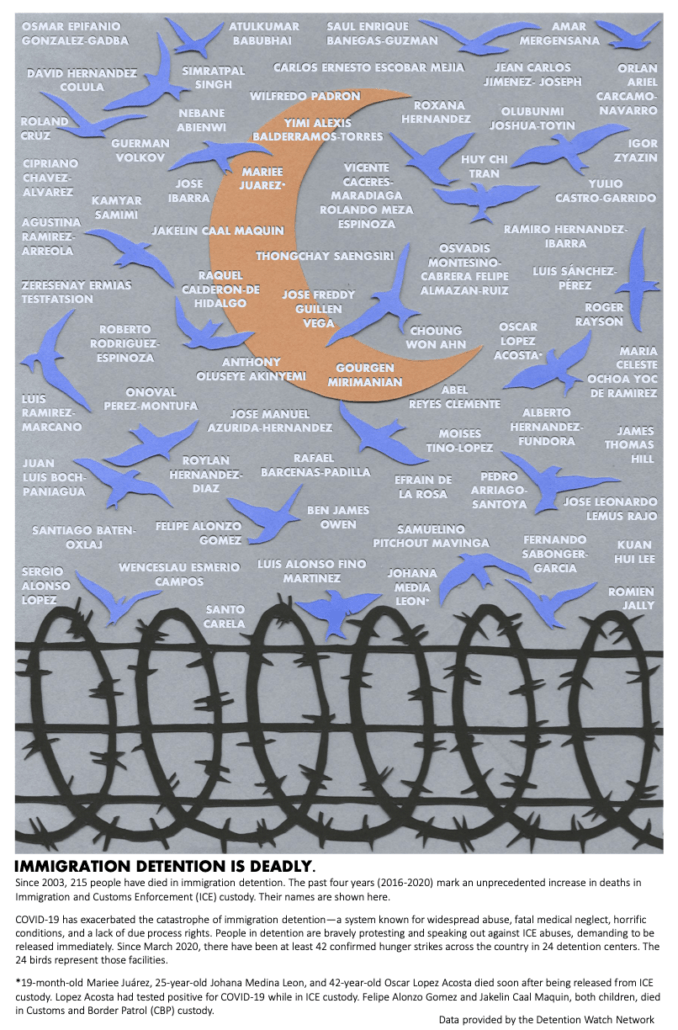
Graphic: Madhuri Shukla, Detention Watch Network, via JustSeeds.org
At issue is the constitutionality of detention without bond, a policy covered by the Fifth Amendment, which the Trump administration has been fighting. In July 2025, Trump ordered that any immigrant who crossed into the US illegally — even those who applied for asylum — can be detained without bond while awaiting court action.
“The Trump administration’s assertion that it can put millions of noncitizens without legal status into immigration detention without bond hearings is on a collision course with the Supreme Court after both sides petitioned the justices,” wrote Bloomberg Law on 23 July. “Getting to the Supreme Court was probably the government’s plan all along, as it has little to lose by holding out,” said Nicole Hallett, director of the Immigrant Rights Clinic at the University of Chicago Law School. The three men were freed on habeas petitions by Texas federal judges in February and March. The panel found that such immigrants have the right to bond hearings within 90 days of being detained. However, the decision was reversed on July 21 by the full 5th U.S. Circuit Court of Appeals, Verite News wrote. A National Immigration Project spokesperson said that following the earlier decision, many more district judges had been ordering release and bond hearings based on it.
In court papers filed earlier this month, the Trump administration indicated it has been deluged by habeas petitions. “This flood of habeas petitions has inflicted a devastating toll on U.S. Attorneys’ Offices as well as district courts — draining those offices’ resources and impeding numerous other significant priorities,” administration attorneys wrote in the filing. Data released by ICE on July 20 show that about 2,000 detainees a month have been freed by court-ordered bond hearings. Courts across the country have ruled quite differently on the policy. Appeals courts covering 10 states have ruled the detention policy is unconstitutional without a class action designation that could make it applicable nationwide. The U.S. Supreme Court is likely to rule on the policy in October.
“’We are prepared to make this case again before the full court. In the meantime, we are hopeful that district court judges will continue to reaffirm these due process rights in individual habeas petitions,” the American Immigration Council and National Immigration Project said in a statement. Stateline reported that the three men were pulled over in traffic stops, have no criminal record, and have US citizen children. They’ve each lived in the U.S. more than 10 years after crossing a border illegally. In detention, the men “experienced rotten food, inadequate medical care, maggot- and fungus-ridden mattresses, and devastating separation from their families,” according to the American Immigration Council.
No hearings for asylum seekers
Bond and detention may not come up for hundreds of thousands of asylum seekers who may be sent directly to deportation proceedings without any hearings, according to a Trump administration plan launched 28 July. (Washington Post). The new rule took effect immediately — without public input — and is designed to reduce 1.4 million pending asylum cases by nearly one third. Previously asylum seekers had the opportunity to apply for refuge after entering the U.S. An asylum office would either reject their application and refer them to immigration court for removal, or allow them to continue proceedings towards citizenship.
“For far too long the asylum system has been exploited for purposes of delay and work authorization, not legitimate claims of protection,” USCIS Director Joseph Edlow said. “America’s asylum system exists to protect individuals who genuinely fear persecution and this rule will help ensure that resources are directed to the timely adjudication of those claims, instead of to those seeking to use the system as a loophole.”
Shocking conditions
Shocking details of detention at 26 Federal Plaza, NYC, and in similar holding rooms in cities around the country were reported by the Washington Post on 22 July. Last May, ICE was pursuing its quota of 3000 arrests per day but had insufficient space to detain people. In NYC, agents began arresting migrants outside their court hearings sending them two floors up to four small rooms. Dozens of detainees were held for days with no beds, showers, medical staff, or even enough room to lie down, the Post reported. Some had heart conditions, diabetes, tuberculosis, ovarian cyst, kidney failure, and mental illness, mostly left untreated.
Immigration officials complained about the conditions, and a federal judge temporarily capped the numbers of detainees held there at 22, warning of a “very serious threat of continuing irreparable injury.” But the Post cited government data indicating that “ICE continued to push the limits of the holding rooms in New York and elsewhere. As of last July, each detainee had about 10 square feet of space, “the equivalent of an old-fashioned phone booth,” the Post reported.
Conditions are probably worse elsewhere: check out the New Yorker’s Locked Away by Jonathan Blitzer on July 13. It’s detailed and harrowing. At the sprawling Camp East Montana at Fort Bliss Texas “deprivation and dire conditions are part of the design,” it begins. “’The idea seemed to be: How can we do this as cheaply and brutally as possible,” Claire Trickler-McNulty, a former senior ICE official, told Blitzer. Camp East Montana had been operated by Acquisition Logistics, a Virginia based firm with no prior detention experience. The New Yorker details the many failings of the contractor as immigrants poured into tents lacking plumbing and water, medical assistance, medications, and communication with the outside world—leading to deaths and lawsuits. The Washington Post reported on 27 July that ICE will keep Camp East Montana open through September 2027 despite calls to close it over reported human rights abuses. ICE plans to extend the no bid contract with Amentum Services, which took over from Acquisition, at a cost of $1.2 billion for the year.
Local resistance
As reported last week, local resistance may have caused the administration to pause or drop its plans to convert several massive warehouses into detention centers. Media have been covering the efforts in several localities across the country. On July 21, Mother Jones reported on “How the Threat of an ICE Detention Center Galvanized a Trump-Country Coal Town.” The magazine recounts how the tiny town of Tremont, PA, came to oppose a facility about to be imposed on it. When the Trump administration bought a former Big Lots warehouse, the school district, county, and township lost $1 million in annual property taxes. The government had no communications with the local leadership about its plans. The scant water supply and sewage had not been taken into account. Local, then state, officials grew alarmed, demanding that ICE submit plans and obtain permits. In June, ICE decided to offload seven of 11 warehouses it had purchased including Tremont. One bonus is that the townspeople—Republican and Democrat—have come together ready to face whatever issue comes next.
Resistance may prove futile
On the other hand, protesting or shutting down ICE centers in blue states may have served only to force ICE to relocate detainees, mostly south, The Atlantic proposed. “The keep-out ICE approach has downsides that Democrats rarely acknowledge,” wrote Nick Miroff in The Atlantic, The Problem with Shutting Down ICE in Blue States. “And now that ICE is swimming in cash, a strategy that relies on starving ICE of resources might turn out to be not just futile but counter productive.” The administration has plenty of money to ship detainees south where detention costs are lower anyway. To keep ICE facilities out of northern cites is “a small-time win” for activists, but leaves detainees worse off,” said former ICE attorney John Gihon, a board member of the American Immigration Lawyers Association. In addition to being far from family members, immigrants will find courts in Texas and Louisiana that have the highest rates of asylum denial in the country and fewer legal aid organizations to help them fight their cases.
ICE ‘border czar” Tom Homan warned NJ Democrats who wanted Delaney Hall closed: “You want to shut down the facility? Then every illegal alien we arrest in that state, we’ll fly to Texas. We’ll fly to Arizona, detain them there, because we’re going to keep arresting people. We’re going to keep detaining people. We’re going to keep removing people.” Miroff, the writer, said the advocates he spoke with “have not yet reckoned with the implications of ICE’s new financial resources, and remain committed to tactics that try to limit arrests and deportations by making it as difficult as possible for the agency to operate in their communities.” Trickle-McNulty, who now advises advocacy organizations, said activists should concentrate on demanding safe, humane detention and fewer detainees. “My view is you want to be very clear on who needs to be detained and for how long, and manage those cases very closely so that people aren’t spending to long in detention.”
Hochul to counties: break up with ICE
Following passage of new legislation, NY Governor Kathy Hochul this week wrote a dozen sheriffs telling them to end agreements with ICE to honor civic detainer requests for undocumented immigrants. Attorney General Letitia James warned that the new Office of Immigrant Trust would take legal action against any police or sheriff department that continues cooperation with ICE through Section 287(g) agreements. The 12 agencies must respond to the letter on the status of those agreements by August 14. Hochul’s Republican opponent Bruce Blakeman has seized on this legislation as fuel for his campaign. “When I become governor, the first executive order I will sign on day 1 is: New York state is no longer a sanctuary state.”
NY officials call for end of ICE
The Daily Freeman reported on 22 July that State Assemblymember Sarahana Shrestha is among 100 NY lawmakers who wrote federal officials demanding the abolition of ICE. Others signing the letter include Ulster County legislators Abe Uchitelle, Greg McCollough, Kathy Nolan, and Joseph Donaldson; Kingston City Council members Michele Hirsch and Michael Tierney; New Paltz Village Mayor Alexandria Wojcik; and Village of Saugerties Trustee Andrew Zink. “ICE ….is designed to terrorize people and cannot be reformed,” Shrestha said in an email. “First, we’ve always had other entities in place to enforce immigration policies, so we don’t even need them…. Second, this administration has made devastating cuts to services like Medicaid and SNAP and in the same gesture given unprecedented funding to ICE.” The letter says that ICE has no “regard for public safety, due process, or human decency.”
Toddlers in Detention
The Marshall Project claims that at least 500 babies and toddlers have spent time in ICE custody during the Trump administration. “ICE has dramatically increased detentions of children aged 3 and under, holding 25 in custody on an average day between January 2025 and March 2026…. Illness and trauma at a critical age have severely impacted many of the children,” it reported. Read the report here.
Odds and Ends
- MSNBC’s Rachel Maddow often covers detention issues in her 9 p.m. Monday Rachel Maddow Hour. Recordings are available later on her website.
- A YouGov poll in March found that three quarters of Democrats and more than half of independents favor abolishing ICE.
- Personal observation: When the Washington Post or NY Times reports on immigration abuses, readers’ comments overwhelmingly criticize the government. When the Kingston Daily Freeman or Albany Times Union report on similar issues, readers overwhelmingly support removal of immigrants and are hostile towards government and/or others defending them.

 Guillermo Arias/AFP via Getty Images