
This resource provides general information only; it is not legal advice. To make an appoinment with UIDN’s volunteer lawyers, call the helpline, 888-726-7276. For additional resources or help finding a private immigration lawyer go to https://ulsterimmigrantdefensenetwork.org/resources/legal/.
We aim to update this page regularly, but the information included here is subject to change at any time without notice.
While having a lawyer is always a good idea when dealing with immigration issues, there are things you can do on your own to help protect yourself and your family in case of arrest or detention by immigration officials. Here is a list of steps to consider if you or someone you know is at risk. It is followed by material that can help.
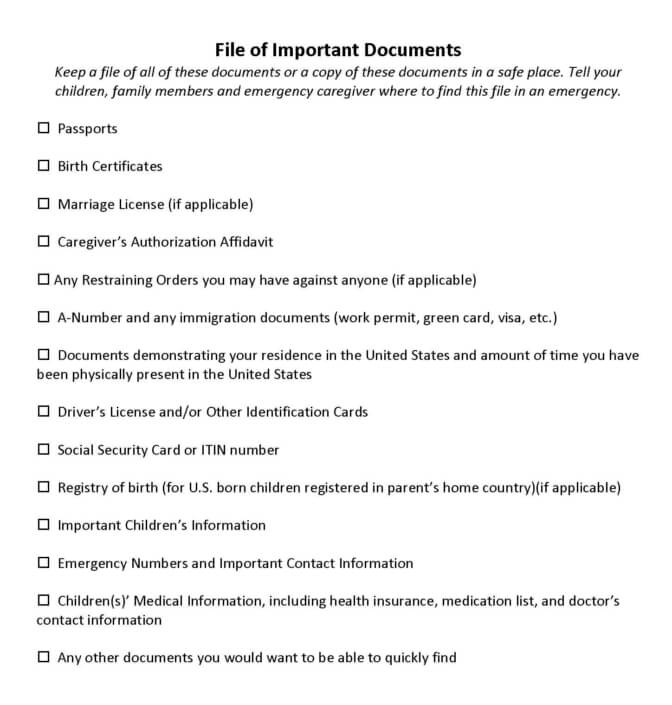
Collect all important documents. Keep them together in a place that everyone knows about. The list shown on this page was created by the Immigrant Legal Resource Center and is available in English or Spanish.
Choose someone to care for any children. There are different ways to arrange care for children. Each one has a different legal meaning. The links below can help you decide which is best for your family and situation.
Ask someone to help with any bank accounts, cars, or other property. This might mean giving someone you trust “power of attorney.” We will soon add a form for this.
Make sure everyone has a passport regardless of age or immigration status. Contact the consulate of your home country to get or renew a passport. If you have children born in the U.S., try to get them passports for your home country and the U.S. Home country consulates also may be able to register children born in the U.S. with your home country. This may grant the child benefits including citizenship in the home country.
Take steps that can help post a jail bond if necessary. Many people will not be able to take this step but it is worth learning more in one of the resources below.
Help for making a plan
While having a lawyer help you make a plan is ideal, it can be difficult to find and pay a lawyer. The materials below may be useful. UIDN volunteers and staff are not lawyers and cannot give legal advice but if you need help understanding options or filling out forms, we may be able to help. Call UIDN’s helpline, 888-726-7276.
A six-page planning guide available in English, Spanish, and Ukrainian, https://www.vlpcny.org/index.php/get-help/immigration/, comes from the Immigration Law Program, Volunteer Lawyer’s Project of Central New York.
This guide is specific to New York State and includes a list of papers to collect. It also explains the different ways you can choose someone to care for children and the legal meaning of each option. The guide has short sections on what to do if you are stopped or detained by ICE or the police and how to prepare to post a jail bond to release you from detention.
A more detailed guide is also available in Spanish, https://www.ilrc.org/
sites/default/files/resources/plan_de_preparacion_familiar.v3.pdf and English, https://www.ilrc.org/sites/default/files/resources/
family_preparedness_plan_v3-20170323.pdf.
Some items are specific to California including the different ways to choose someone to care for children and the legal meaning of each option. It also has short sections on what to do if you are stopped or detained by ICE or the police. The English version is 14 pages, English; the Spanish is 20. This material comes from the Immigrant Legal Resource Center.
Documents to carry, or not
If possible, ask a lawyer about what documents to carry with you. The National Immigration Law Center and the Immigrant Legal Resource Center says generally it is best to carry:
- Any evidence that you have been in the U.S. for longer than two years, such as mail received at your home address with a postmark, a signed lease, church or school records with your address, etc. You may want to carry copies with you so as not to risk losing your originals. Share this evidence if / after you have been taken into custody.
- Any evidence of lawful entry or current lawful status in the U.S. if you have For example, a pending asylum application or other immigration court case or appeal. Share this evidence if or after you have been taken into custody. The first step is to remain silent with the exception of asking to speak to a lawyer.
- A valid work permit or green card, if you have one.
- A municipal ID, state ID, or U.S. driver’s license unless it includes your immigration status or country of origin. In the Hudson Valley the following communities offer municipal IDs: Poughkeepsie, Middletown, Newburgh, Kingston, Beacon, and Woodstock. Get details and forms: https://ulsterimmigrantdefensenetwork.org/
municipal-id-cards/ - A Know Your Rights card. Download cards in Spanish, English, and several other languages at https://www.nyic.org/resources-training/kyr/#1/. (They are found about mid-way down the page.)
- The phone number of someone who can put your plans into place, call your immigration attorney, and gather your important documents in an emergency.
The National Immigration Law Center and Immigrant Legal Resource Center say generally it is best NOT to carry:
- Documents from your country of origin.
- False identity papers of any kind.
How to find someone detained by immigration
Use ICE’s detainee locator, https://locator.ice.gov/odls/homePage.do, to find anyone over 18. Using the person’s A-Number (found on immigration documents) is best. If you don’t have it, search using the person’s name, birthdate, and country of origin.
If you have an A-number, you also can call the U.S. Dept. of Justice at 800-898-7180 to see if you or someone is on a ‘deportation list’ or to get information about immigration-related court dates, bond hearings, and other proceedings.
If you are looking for a minor who may have been detained the Office of Refugee Resettlement National Call Center (Spanish and English) helps parents and sponsors. They may also answer questions from children and parents about issues such as trafficking, homelessness, and violence. Call 800-203-7001 or email information@ORRNCC.com.
Office of Enforcement and Removal Operations (multiple languages) answers questions and works to resolve problems including separation of minor children or other dependents. Call 888-351-4024, weekdays, 8 a.m. to 8 p.m., closed holidays.
 Skylight.Is
