
Back-to-school night for activists & educators
Some 80 educators and activists from Ulster, Greene, Dutchess, and Columbia counties met in September 2019 to learn from each other and consider ways to support immigrant students and their families. While time has passed, the themes and stories that seemed to echo from every speaker and districts remain useful. We hope these ideas will help guide anyone working with the schools and young people in other settings.
Jo Salas, a member of UIDN’s Schools Outreach Committee, opened the session by telling the group, “Our job is to strengthen what the schools are already doing, to build connections, and respond to needs.”
Shared principles
Make sure schools are safe places. Some districts, such as Kingston and Rhinebeck, sent letters home explaining that ICE may not interview students at school and that school personnel are not permitted to give ICE student records. These letters are backed up by guidance from the NYS attorney general and NYS Education Dept. Other districts, including Onteora, have adopted safe zone policies.
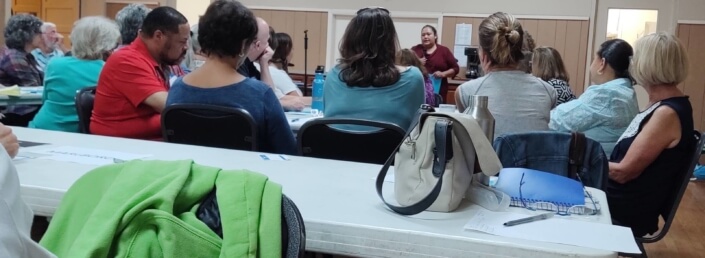
Presenters included: Stacia Felicello, assistant superintendent for Elementary & English as a New Language (ENL) Education, Kingston City Schools
Juan Flores, former NYC teacher & school administrator, Columbia County Sanctuary Movement
Patty Grossman, Woodstock Immigrant Support & UIDN
Marjorie Leopold & Jo Salas, UIDN
Veronica Martinez (shown above), Kingston parent, member, Nobody Leaves Mid-Hudson
Robin Osswald, ENL teacher, Phoenicia Elementary, Onteora Central School District
Use existing programs, but work for improvements. Kingston’s Stacia Felicello and other school staff were open about the need for improvement, but Juan Flores reminded us that existing programs, such as after school enrichment and summer school, can help students improve their English and catch up on any academics they may have missed. He advised teachers to recommend ENL students for all available programs and encouraged families to sign up for them whenever possible.
Partner with parents & community groups. Veronica Martinez stressed the need for families to be educators and for schools to recognize them as such. She also uses the skills she has developed as an activist with Nobody Leaves Mid-Hudson to ensure her children get the best education available. NLMH works to empower families and improve communities and their institutions.
Acknowledge feelings & trauma. Robin Osswald, an ENL teacher for 20 years, told the group that the current political climate promotes “increasing anxiety, fear, and instability” among students and families. The result, she said, is that it can be “difficult and scary to come to school activities. The fears are real and the consequences are real.”
Learn from others. Felicello said the district learned a lot from North Rockland Central School District where students come from families who speak 31 different languages and hail from 43 countries with 35% indicating that Spanish is their home language.
Help ensure that families know their rights. New Paltz, Onteora, and other districts have held workshops to explain students’ rights and to help families plan for temporary guardianship in case it’s needed. Flores is among those available to lead such sessions. He can be reached at SanctuaryColumbiaCounty@gmail.com.
Interpretation & transportation are key and pose challenges in virtually every district. While religious congregations, community groups, and activists can help fill the need for interpretation and transportation, most agreed that professional, paid interpreters are the ideal and that more robust public transportation options are needed.
“Kids are anxious because they’ve heard stories about the knock at the door.” – Juan Flores, Columbia County Sanctuary Movement
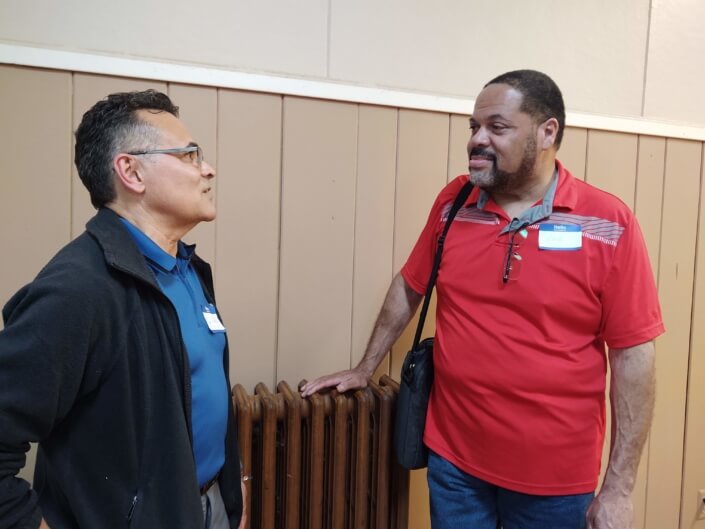
Juan Flores and Steve Spicer